


In the Works
A Digital Journal from
San Francisco Public Works
JULY 2026


The Rest of the Lineup

Excelling in the Excelsior: New Streetscape Upgrades to Improve Safety,
Accessibility
We celebrated the completion of the Mission Street and Geneva Avenue Infrastructure Improvement Project, a multiagency initiative aimed at improving safety and accessibility along the busiest commercial corridor in the Excelsior neighborhood.

.jpg)
NUMBERS
2026 YTD (through the end of June)
by the

185
blocks resurfaced

7826
TREes PRUNED

12439
tons of debris collected

3680
potholes filled

225
curb ramps constructed

Volunteers who came out for One City Day on July 11 pose for a group photo on Treasure Island.

On Mt. Davidson, beneath towering eucalyptus trees rising 12 stories above a blanket of fog, a group of volunteers worked in the chilly air to remove weeds that were crowding out the area’s native plants.

In District 7, volunteers remove weeds to protect native plant species on Mt. Davidson.
Meanwhile, near Mission Creek Park, where it was sunnier and floating homes line the adjacent channel, dozens of volunteers from a tech company tackled the litter strewn across Townsend Street, between Seventh and Fourth streets, then moved north along Fourth Street until they reached Bryant Street.
At Jefferson Square Park, just west of San Francisco's Civic Center, nearly 30 volunteers planted a primrose tree along with a variety of native plants, helping to restore the park's landscape.

Volunteers hard at work planting new plants in Jefferson Square Park.
They were all there for One City Day, a citywide day of service on July 11 that was the vision of San Francisco First Lady Becca Prowda, married to Mayor Daniel Lurie and a longtime champion of cultivating a culture of service to improve our communities.

First Lady Becca Prowda (center, arms crossed), the visionary behind One City Day, poses for a photo with volunteers.
“One City Day was a love letter to San Francisco – written by more than 4,000 San Franciscans who gave their time, their energy and their heart to this city,” Prowda said after the workday.

Volunteers remove overgrown vegetation on the shore near a Treasure Island marina.
Across all 11 supervisorial districts, the thousands of volunteers from every walk of life rolled up their sleeves to support their neighbors and their neighborhoods. Working alongside nonprofit partners, community organizations and nearly every City department, volunteers participated in some 180 service projects that strengthened communities and improved public spaces.

A volunteer picks up litter at Crissy Field Beach.
For some participants, this was their first foray into volunteer work; others have been giving back for years.
Sophie Constantinou, who long has led community-driven volunteer efforts in the Bernal Cut area bordering Bernal Heights and Glen Park, was out with a group of One City Day participants at Lyell Hill. There, they've been working to transform the small patch of public land near Bosworth and Lyell streets into a welcoming green space and pollinator refuge. She said it's been a team effort.
“Public Works has been helping our neighborhood stewards pull this transformation off with heavy equipment, lending us lots of tools and picking up our green waste monthly.”
And the One City Day event buoyed the ongoing efforts.

Volunteers at the Lyell Hill One City Day project show their enthusiasm. (Photo courtesy of Sophie Constantinou.)
“We got a handful of new folks pulling weeds and raking mulch. It was great to meet new neighbors. And to see all the other volunteers at work across the City,” Constantinou said. “We were visited by the garbage-picking volunteers and our favorite government representatives.”
She said it was similar to a typical volunteer workday, but “with a little more buzz.”

The tables at the Treasure Island YMCA get a fresh coat of paint.
Volunteers distributed clothing, served meals, made toys for shelter animals, cleaned community centers, assembled hygiene kits for people experiencing homelessness, packed backpacks with back-to-school supplies for children in need and much more.
Public Works has a long tradition of working with community volunteers to improve San Francisco neighborhoods and for One City Day played a central role in the greening and cleaning projects, providing staff expertise, equipment and logistical support for litter pickup, graffiti removal, tree planting and weeding projects across San Francisco.

Volunteers spread mulch at McCoppin Square Park.
Behind the scenes, coordinating a citywide day of service on this scale was a monumental undertaking. Shannon Sweeney of the Public Works Community Engagement team led the department's efforts, coordinating arborists, drivers, cleaning crews, communications staff and many others to ensure each project had the tools, supplies and support it needed. Her colleague, Eva Chang, was instrumental in getting the online registration portal up and running.

Shannon Sweeney of the Public Works Community Engagement team led our department's efforts for One City Day.
The Public Works team also managed trash and compost collection throughout the day while working closely with other City agencies and the First Lady to keep operations running safely and seamlessly.
The day was a great success, generating overwhelmingly positive feedback from all who were involved!

A group of young volunteers has tools handy for work during One City Day.
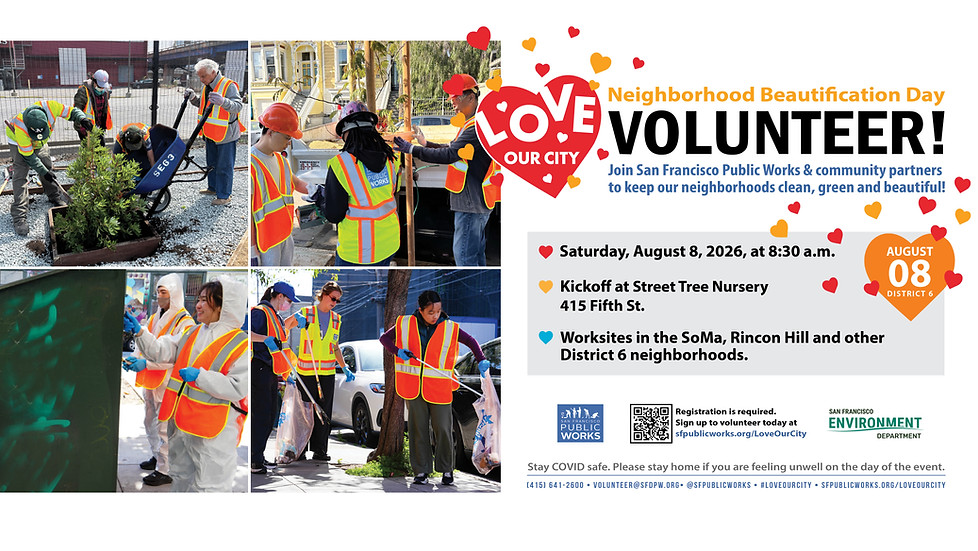
One City Day was built on the same spirit as our monthly Neighborhood Beautification Day volunteer events – only on a citywide scale.
Our regularly scheduled beautification day was incorporated into this larger effort, but next month we’re back to our regular groove on Aug. 8 in District 6, serving SoMa, Rincon Hill and other neighborhoods in the district. The event kicks off at the Public Works Street Tree Nursery (415 Fifth St.), with registration from 8:30 to 9 a.m. Sign up below.

“It’s a wonderful feeling to meet up with your neighbors over a shared purpose – to clean up your neighborhood. And it’s easy, too,” said Glen Park resident Bonnee Waldstein, a One City Day participant who is a seasoned volunteer with a monthly group cleanup in her neighborhood.
She encourages folks to build on the momentum of One City Day – not just because of the good work that gets accomplished but also because of the community-building that results.
“You get to know a lot of neighbors you wouldn’t ordinarily meet up with,” she said. “I’ve made a lot of friends through the monthly cleanups. There’s camaraderie and a sense of achievement when it’s all done – until the next month!”

Glen Park's Bonnee Waldstein, left, heralds volunteering — not just for the work that gets done but also for the sense of community it sparks.

A rendering shows what the new and improved Chinatown Public Health Center will look like after the modernization work.
Critical Care for Chinatown: Major Modernization Work on Healthcare Hub Kicks Off
Public Works joined Mayor Daniel Lurie, City officials and community members to break ground this month on a major modernization of the Chinatown Public Health Center, a project that will deliver significant clinical improvements and important seismic upgrades.
The $76 million modernization project at 1490 Mason St. is being led by the San Francisco Department of Public Health and Public Works, which is managing the retrofit and upgrades at the health center, as well as spearheading the architectural design.
The health center project will include a full seismic retrofit to strengthen the health department’s most seismically vulnerable clinic in the network. The new design will integrate primary and medical care with mental and behavioral health services, expand dental care, increase the number of exam and consultation rooms, improve accessibility with barrier-free access, upgrade restrooms, make elevator enhancements and enhance air quality and ventilation. The project also will co-locate the health center with the Chinatown Child Development Center, improving access to behavioral health services for the community.

A group of performers put on a show in front of the Chinatown Public Health Center during the groundbreaking ceremony.

The Public Works team and others pose for a photo during the groundbreaking ceremony.
“The Chinatown Public Health Center plays an indispensable role in keeping San Franciscans healthy and cared for,” said Public Works Director Carla Short. “These critical upgrades that we’re delivering in partnership with the Department of Public Health will ensure that the services the community relies on will continue in a setting with improved accessibility, seismic resilience and a new layout for expanded patient care.”
Since the Chinatown Public Health Center closed in June, patients have been receiving healthcare services from their typical providers on the fourth floor of Chinese Hospital nearby. The health department worked closely with community members to provide a seamless transition for patients, making sure health services were offered during construction.
City departments are coordinating closely with residents and merchants to minimize traffic and construction impacts.
The Chinatown Public Health Center sits directly above the Broadway Tunnel, and the building’s structural supports are connected to the tunnel. To safely complete the seismic work, the Broadway Tunnel is tentatively scheduled to be fully closed the weekend of Aug. 15-16. Then, immediately following the full closure, one of the tunnel’s two bores will be closed at a time and reconfigured to accommodate two-way traffic, one lane in each direction. This change will last approximately 14 months. Detour routes will be set up, but motorists should expect delays during peak travel time.

A rendering shows what the renovated Chinatown Public Health Center will look like at the Broadway Tunnel entrance.
Despite its unusual location atop a tunnel and busy east-west artery, the healthcare hub in the City’s northeast corner has played a pivotal role in delivering care to generations of San Franciscans.
The Chinatown Public Health Center, formerly known as Health Center Number Four, has proudly served San Franciscans at its current location – with an emphasis on the Chinese and Asian American community – since 1971, providing culturally competent healthcare with a focus on low-income and limited or non-English-speaking patients. The health center provides primary medical and behavioral healthcare services, dental care, podiatry, acupuncture, nutrition services, clinical pharmacist visits and a nurse’s clinic. Owned and operated by SFDPH, the clinic serves nearly 4,000 patients annually with nearly 20,000 patient visits.
Funding for the two-and-a-half-year project comes in part from the voter-approved Healthy, Safe, and Vibrant San Francisco Bond. More than $200 million from the $390 million bond is earmarked for healthcare infrastructure improvements, including $71 million dedicated to the full seismic retrofit and renovation of the Chinatown Public Health Center. An additional $5 million comes through the state’s voter-approved Behavioral Health Services Act.

City officials and community members cut the ribbon for the Mission Street and Geneva Avenue Infrastructure Improvement Project.
Excelling in the Excelsior: New Streetscape Upgrades to Improve Safety, Accessibility
Community leaders and City officials celebrated the completion of the Mission Street and Geneva Avenue Infrastructure Improvement Project, a multiagency initiative aimed at improving safety and accessibility along the busiest commercial corridor in the Excelsior neighborhood.
The project has transformed Mission Street, from Geneva Avenue to the Highway 280 overpass near Trumbull Street, with new paving, sidewalk bulb-outs, curb ramps, bus bulbs and upgraded traffic signals at several intersections – making travel safer and more welcoming for people whether they are on foot, on a bike, on Muni or in a car. Similar safety upgrades and infrastructure improvements were made to Geneva Avenue, from Prague Street to Mission Street.
The infrastructure upgrades packed a punch – 87 new curb ramps, 70 new traffic signal poles, 34 bulb-outs, 22 streetlight replacements, 17 concrete bus pads, three bus bulbs, two raised crosswalks, tens of thousands of square feet of new concrete street base and thousands of tons of fresh asphalt.
Pedestrians use the crosswalk at the intersection of Mission Street and Norton Street.
Traffic rolls along Mission Street.
A pedestrian uses the crosswalk along Mission Street.
“Today we’re celebrating much more than a completed infrastructure project. We’re celebrating an investment in people, local businesses and the future of the Excelsior,” Laura Padilla, executive director of the Excelsior Action Group, said at the July 10 celebration. Joining her were Mayor Daniel Lurie, District 11 Supervisor Chyanne Chen and representatives from Public Works and the San Francisco Municipal Transportation Agency.
“Mission Street is the heart of our neighborhood. Every day, children walk to school, seniors access essential services, families shop at locally owned businesses and thousands of residents travel this corridor,” Padilla added. “These improvements make those everyday journeys safer, more welcoming and more accessible.”
Key improvements of the Mission Street and Geneva Avenue Infrastructure Improvement Project include:
-
New curb ramps to improve sidewalk accessibility
-
Raised crosswalks to reduce vehicle speeds and bulb-outs to shorten crossing distances for pedestrians
-
New traffic signal poles and streetlight replacements
-
New concrete bus pads and bus bulbs
-
A new transit boarding island, a traffic island and a mid-block crosswalk
-
Concrete street base replacement to prolong the life of the roadway and fresh paving
-
Upgrades to the overpass across Highway 280 to improve its reliability and lifespan
-
Rehabilitated and replaced sewer main lines

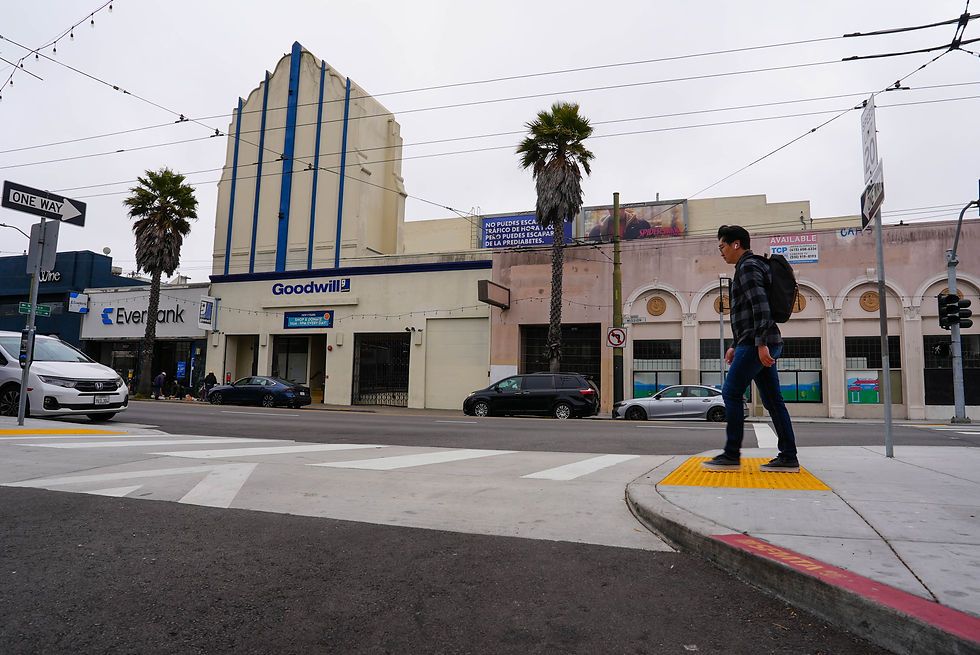
A pedestrian uses a new raised crosswalk along Mission Street in the Excelsior neighborhood.
Public Works designed the project and handled construction and project management on behalf of the SFMTA and the San Francisco Public Utilities Commission.
Mission Street and Geneva Avenue are part of San Francisco's Vision Zero High Injury Network – the 13% of City streets where 75% of the severe and fatal collisions occur. Over seven years, five community members were killed and at least 323 people were injured in crashes in the project area. Additionally, on some blocks of the project corridor, the eight Muni lines that serve the neighborhood have average speeds below 5 mph.
The project helped address these concerns while making loading improvements to support the existing storefronts along Mission Street and Geneva Avenue.
Funding sources for the project included Proposition AA Vehicle Registration Fee dollars, Proposition K Sales Tax Program, Highway User Tax Account, Road Maintenance and Rehabilitation Account, 2020 Health and Recovery Bond, Waste Water Enterprise Renewal and Replacement Funding and Municipal Transportation Authority Grant Funding.

.jpg)
Community volunteers work alongside Public Works arborist staff to improve the root flares at the base of Sunset Boulevard greenway trees.
Caring for Sunset Boulevard from the Roots Up
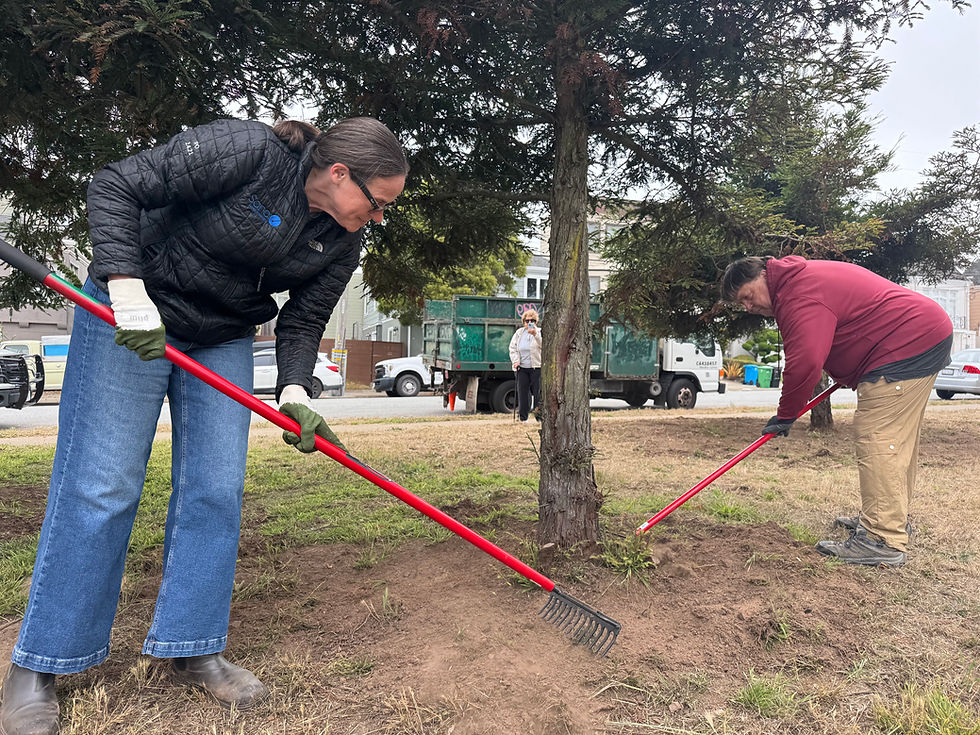
The steady scrape of rakes and corn brooms filled the air along Sunset Boulevard as volunteers gently cleared decades of soil and sand from the base of mature trees. A cool marine breeze rustled through the evergreens overhead while joggers, cyclists and dog walkers passed by.
The work is known as root flare rehab: a simple practice with long-term benefits for trees growing along the City’s westside greenbelt.
The root flare is where the roots of the tree flare out from the main trunk, serving as an anchor for the tree.
Starting at Irving Street and working south, volunteers with Friends of Sunset Boulevard teamed up with arborists from the Public Works Bureau of Urban Forestry to expose each tree’s root flare.
.jpg)
Volunteers learn the proper techniques to keep the root flares exposed.
.jpg)
Bureau of Urban Forestry Superintendent David Moore (kneeling) uses this tree as an example of a properly maintained root flare.
Removing accumulated soil and debris from this area helps prevent root rot and improve tree health and longevity. In essence, it helps the roots breathe.
“Hundreds of trees along the boulevard need this kind of care, and it’s a perfect example of the community working alongside Public Works to accomplish something meaningful,” said Bureau of Urban Forestry Superintendent David Moore.
The volunteer work complements ongoing efforts by Public Works arborists, who prune mature Monterey pines, cypresses and other species along the boulevard to support tree health and safety.
“This work has been on our to-do list for a long time,” Moore said. “By showing volunteers how to do it safely and correctly, we can accomplish more together than we could on our own.”
.jpg)
Volunteers with Friends of Sunset Boulevard use rakes to clear weeds from the base of a tree.
For volunteer John Crabtree, the project demonstrates that caring for the urban forest extends beyond planting new trees.
“Five or 10 minutes of work can undo years of buildup around a tree,” he said. “Preserving these established trees is just as important as planting new ones. If we can keep the trees we already have healthy while adding new ones, our neighborhood canopy grows stronger.”
Crabtree said the partnership also creates an opportunity to build a broader community of tree stewards. “The arborists don’t just teach us how to do the work,” he said. “They teach us so we can share what we've learned with others, bring more people into the effort and grow community involvement.”
Together, Public Works and the force of volunteers demonstrate that preserving the urban forest is a shared responsibility.
.jpeg)
The recently renovated Southeast Behavioral Health Center (left) sits next to the new Southeast Family Health Center primary care clinic.
New Southeast Behavioral Health Center Opens
A newly refreshed healthcare hub in San Francisco’s Bayview-Hunters Point neighborhood opened its doors this month following a Public Works-led makeover of the space, which once housed the City’s Southeast Health Center.
In partnership with the San Francisco Department of Public Health, which runs the facility, Public Works helped renovate the former health center at 2401 Keith St. to allow for two behavioral health programs currently operating at separate sites – the Southeast Child Family Therapy Center and Families Rising Behavioral Health – to move into the upgraded space.
%20-%205.jpeg)
The interior of the new Southeast Behavioral Health Center
sports vibrant, modern finishes.
%20-%207.jpeg)
A young visitor takes advantage of the upgraded space inside the new Southeast Behavioral Health Center.
The renovation project – known as the Southeast Behavioral Health Center Renovation Project – aims to expand access to critical behavioral healthcare and support services for children and families in Bayview-Hunters Point. The project design also allows for potential future expansion of both behavioral health programs in the remodeled building.
The project scope included modernization of outdated mechanical, plumbing, electrical and fire alarm systems, along with exterior improvements to refresh the building’s appearance and an upgrade to vibrant, modern interior finishes. Construction kicked off in June of last year and crews achieved substantial completion this month.
Public Works led the architectural design and provided construction management, project management, engineering and landscape architecture design services.
%20-%204.jpeg)
A person enjoys the outdoor space at the newly refreshed Southeast Behavioral Health Center.
The $15 million project was funded with state and federal dollars, including $14 million from the state's Behavioral Health Services Act.
The Southeast Behavioral Health Center sits next to the health department’s new Southeast Family Health Center primary care clinic, which opened in 2022 and was designed and built from the ground up by Public Works.
The proximity of the new primary care clinic to the upgraded behavioral health center creates opportunities for stronger integration between primary care and specialty behavioral health services to improve the client experience.

Crews repave the windy road leading to and from Coit Tower.
The Road to Success: Public Works Again Bests Paving, Curb Ramp Targets
Public Works not only met but exceeded targets set for roadway and curb ramp upgrades during the just-concluded fiscal year – showcasing our commitment to improve the condition of our streets and expand accessibility.
➢ 563 blocks paved (target of 500)
➢ 182 curb ramps constructed by Public Works (target of 175)
The department bested the yearly 500-block paving target for the fiscal year that ended June 30, paving 563 blocks. The effort will help keep San Francisco on track to maintain the best paving condition rating among big Bay Area cities.
Overall, during the past 15-plus years, more than 9,000 – or two-thirds – of San Francisco’s roughly 13,000 City-maintained blocks have been resurfaced.
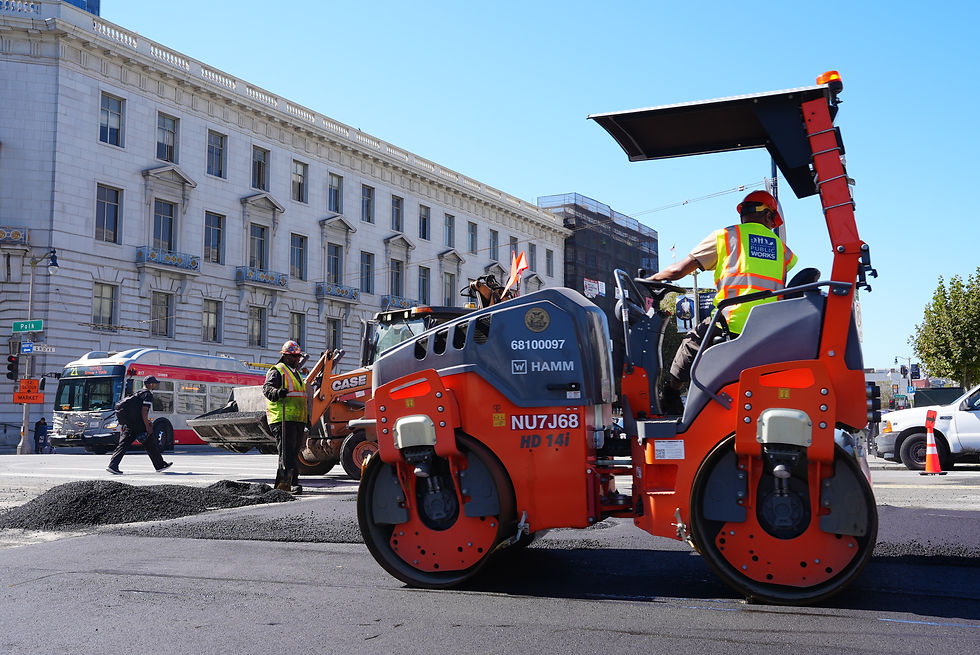
Crews pave Polk Street near City Hall.
Giants mascot Lou Seal rides along a new bike lane in the Mission Rock neighborhood.
Public Works’ Street Resurfacing Program paved streets in neighborhoods throughout San Francisco during the last fiscal year. Both in-house Public Works asphalt crews and City contractors performed the critical work.
The resurfacing program follows industry best practices by preserving streets in good condition instead of letting them deteriorate. This approach is the most cost-effective.
Extending the life of a block in San Francisco that is in good condition can cost as little as $50,000. By comparison, the price to completely reconstruct a block in very poor condition can be as much as $500,000 or more.
The driving philosophy of the program: “Treat the right road with the right treatment at the right time for the right price.”

Pedestrians and bicyclists use new protected pathways along Terry Francois Boulevard. Photo credit: Arianna Cunha, Port of San Francisco

Curb Ramps
The Public Works Curb Ramp Program also met and exceeded its goal last fiscal year.
Citywide, 719 curb ramps were constructed in Fiscal Year 2025-26. This was a collective effort between various Public Works programs, City agencies and third-party utility companies.
Of the total curb ramps built across San Francisco last fiscal year, 182 were constructed by the Public Works Curb Ramp Program, meeting and exceeding the program goal of 175.
For people with mobility challenges, curb ramps are essential for providing an accessible path of travel onto and off of public sidewalks, making it easier to get around. Public Works, through its Curb Ramp Program, is committed to providing equal access to all City residents.
Crews work on a curb ramp.
