In the Works
A Digital Journal from San Francisco Public Works
SEPTEMBER 2026

Feature Story
Not far from Chase Center, a rusting 900-foot structure floats, subjected to years of deterioration and storm damage. Recently, Public Works and contractor crews raced to stabilize the aging dry dock – welding underwater, installing sensors and dismantling massive cranes – to keep it afloat until its final demolition.


The Rest of the Lineup
This Tunnel Vision Looks at the Bigger Picture
For more than half a century, the Broadway Tunnel has served as a high-capacity portal between North Beach and Chinatown to the east and Russian Hill to the west. But the structure is showing its age and with the tunnel shut down for another construction project, Public Works has a once-in-a-generation opportunity to address the problems.

Love Our Neighborhoods: A Bridge to Success
A once gray and graffiti-covered pedestrian bridge in Glen Park recently received a whimsical burst of beauty. Neighbors, volunteers and Public Works crews teamed up to repaint the bridge and install colorful tiled murals, transforming a neglected walkway into a striking neighborhood landmark through Public Works' Love Our Neighborhoods program.

Bucketsful of Dedication Build Community, Improve Our Neighborhoods
Scores of volunteers were on hand as part of September’s Love Our City: Neighborhood Beautification Day. This month, the rotating greening and cleaning workday focused on Golden Gate Heights, Lakeside Village and other neighborhoods in District 7.

NUMBERS
2026 YTD (through the end of August)
by the

375
blocks resurfaced

16172
TREes PRUNED

15570
tons of debris collected

4753
potholes filled

312
curb ramps constructed

A drone flying the length of Dry Dock 2 captures the immense size of the structure.
What’s Up, Dock?
The Race to Stabilize
a Floating Behemoth
Not far from Chase Center, where a barrage of three-point shots routinely haunts opposing squads, the frigid, green-blue Bay harbors a ghostly relic.

The Bay Bridge rises in the distance as Dry Dock 2, once the largest floating dry dock in the world, sits empty.
Flanked by empty warehouses, squat barges and long-idle cranes, this colossus of rusted metal, sharp edges and discolored side panels has sat without a purpose for nearly a decade.

Rust and corrosion pocks the dry dock’s exterior.
It’s not technically a ship, but its enormous dimensions make it seem like a post-apocalyptic oil tanker. A rectangular behemoth of floating metal some 900 feet long with walls about 80 feet tall. Walking across its immense midsection makes you feel small and alone.

Public Works Project Manager Tony Abuyaghi tours the dry dock on a recent site visit.
Its deck looks and sounds like a Martian desert with shimmering hues of rusted brown, golden amber and burnt orange. Oxidized particles crunch beneath every step. Thanks to stiff seaside gusts, heavy metal doors along the walls creak open as if pulled by roaming spirits.

Public Works Project Manager Tony Abuyaghi walks across the weathered dry dock deck.
“I think it’s an engineering marvel,” said Public Works Project Manager Tony Abuyaghi on a recent site visit to Dry Dock 2, the antiseptic name for the leviathan of corroded steel. “It’s quite impressive.”
But the vast vessel ran into trouble last fall. The mayday came in November. A tugboat operator notified the Port of San Francsico that there was excessive listing. The dry dock was taking on water.

Storms have hastened the dry dock’s demise over the years.
In early December, the Port of San Francisco issued an emergency declaration, allowing the dry dock to be stabilized without delay before its eventual demolition. Public Works was brought on board to help deliver the project.
“We jumped in quickly. We reached out to five marine contractors,” Abuyaghi recalled, highlighting the strong partnership between Public Works and the Port. “All hands on deck really. It was quick.”
Originally built by the Bethlehem Steel Corporation, the 55-year-old dry dock – once used to repair and maintain large ships – has itself fallen into disrepair. The Pier 68 Shipyard, the homebase for Dry Dock 2, has been without a tenant performing ship repairs or dry dock maintenance since 2017. Inadequate maintenance of Dry Dock 2, once the largest floating dry dock in the world, was a major factor in the closure of the shipyard.
A functioning floating dry dock is a massive U-shaped vessel that can be ballasted down to allow a large ship to be floated in between the two vertical wing walls. The ballast water is then pumped out to lift the ship and the dry dock back out of the water so crews can perform repairs and maintenance to the ship’s hull. But without an operational shipyard facility, Dry Dock 2 continued to deteriorate for years. So, officials began planning its final voyage.
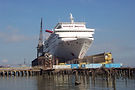
An archival image of a large cruise ship in Dry Dock 2.
The Port hired Herbert Engineering, a Bay Area-based marine consulting firm, in December 2024 to prepare designs for stabilization repairs that will enable the dry dock to remain afloat until it can finally be removed.
Inspections by the consultant team documented extensive hull tears near the waterline of the vessel, and welded steel repairs were designed.
But Mother Nature had other plans.
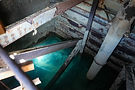
Sunlight illuminates water inside one of the dry dock’s ballast tanks.
Last fall, storms tore into the structure, enlarging existing tears in the hull. New slits appeared, too, leading to additional uncontrolled flooding of ballast tanks and unsafe listing of the vessel.
The Port installed rented auxiliary industrial pumps to pump out the ballast tanks where the dock’s onboard pumps no longer functioned. The auxiliary pumping required Port staff to monitor the water levels visually and move portable pumps from tank to tank around the clock.
Still, emergency repairs were needed so the dry dock could stay afloat until it was ready for a final disassembly. “If this was to sink in the Bay, that would be a huge issue,” Abuyaghi said.
The Port and Public Works teams collaborated to solicit and issue an emergency contract. Public Works assisted with project management, regulatory affairs, contract prep, construction management and contracting for the crucial emergency fixes.
Abuyaghi credited Public Works’ contract prep group, contract administration team and accounting staff with expeditious work. “You need all of those pieces to work,” he said. “You need the funding in place. We need approvals before we can even get going. It’s really an amazing effort.”
Work started in earnest in January, a lightning quick turnaround for a project of this magnitude.
To repair the tears, crews installed engineered steel patch plates that were welded onto the sides of the wing walls.

The dry dock’s walls show visible signs of rust.
Divers even took to the Bay to complete the repair work.
They welded the submerged portions of steel plates that had been installed on the dry dock hull, said Steph Boyd, project engineer for Power Engineering Construction Co., the Alameda-based marine contractor the City hired to perform the work.
“Underwater welding works similarly to conventional welding, but divers use specialized electrodes with waterproof coatings designed for wet welding applications,” Boyd explained. “Working underwater can be challenging due to limited visibility, access, and the difficulty of positioning and maneuvering while submerged.”

A diver captures some of the underwater work on the dry dock.
In order to inspect the underwater work – since Public Works doesn’t have its own divers – the contractor provided the Port and Public Works team with videos and photos of the underwater welds.
“So that was unique,” Abuyaghi said.
Additionally, and importantly, crews also installed an electronic monitoring system at the dry dock to allow Port staff to remotely track whether it is sinking or listing.
All told, six sensors were installed along the dry dock – one at each corner and two in the middle. They were mounted externally to the wing walls, with the readings routed to a central computer in the dry dock control room.
“This allows the Port team to monitor the dry dock’s condition and determine when water needs to be pumped from its 40 compartments to maintain stability,” Boyd said.

Drone footage shows the dry dock’s two sizable cranes.
Two large cranes, one atop each side of the sky-high wing walls, also had to come down to make sure they didn’t fall over. That part of the work, alongside developing the supplemental mooring system, was the most challenging, Boyd said.
“We had a lot of unknowns going into the project due to the condition of the dry dock, so working closely with the Port, engineers, and other stakeholders to develop solutions that worked for the site was a valuable part of the project,” she said.
As part of the work scope, crews also removed 127 timber piles from the water surrounding the dry dock. The piles, remnants of a pier that once stood there, had to be taken out so crane barges could work alongside the walls.
Further adding to the project’s complexity: a limited timeframe when the in-water work, such as pile removals, could be performed to conform with environmental regulations. In that part of the Bay that window runs from June to November, Abuyaghi said.

Disassembled crane parts sit atop the dry dock bed.
“Anything out of that time, you have to get additional approvals from regulatory agencies,” like the U.S. Army Corps of Engineers, the San Francisco Bay Regional Water Quality Control Board and the San Francisco Bay Conservation and Development Commission, he said. “So we couldn’t actually do work right away, because we needed those emergency clearances.”
The Port’s environmental team and the Planning Department worked with Public Works’ in-house regulatory affairs group to get all the emergency approvals needed, Abuyaghi said, adding that they did “an amazing job.”
Staff also conducted an analysis to make sure no wildlife was in the area that could be disturbed by the work.
Reflecting on the project’s myriad of unusual challenges, coupled with the inherent time crunch, Abuyaghi praised the teamwork and partnership between the Port, Public Works and the contractor.
“We were just super impressed with how they delivered the project,” he said.

Public Works Project Manager Tony Abuyaghi motions at the dry dock’s walls during a recent site visit.
By mid-September, on one of Abuyaghi’s most recent visits to the dry dock, work was beginning to wind down.
Crews were welding a bracket onto the dry dock wall as part of the supplemental mooring system they’re installing and working on adding a threaded rod system.
Gentle waves lapped against the hull and a strong breeze whipped around the edges of the dry dock as Abuyaghi, standing on a narrow catwalk, marveled at the heavy metal plates and vertical reinforcements that had been welded to the wall.
“It seems like a simple fix,” he said. “But the engineering behind it is crazy.”

Contractor crews remove the mounted dragon sculpture from the health center façade, one rivet at a time.
Dragon’s Delicate Deinstallation
At 56 feet long and 9½ feet high, the bronze and brass dragon sculpture affixed to the facade of the Chinatown Public Health Center – perched atop the Broadway Tunnel – had to come down after 56 years.
The job was far from simple.
Under the watchful eyes of art preservationists, contractor crews from ARG Conservation Services and Atthowe Fine Art Services worked for two days to complete the delicate operation.

Crews carefully ready a piece of the metal sculpture for a short crane ride.
Crews reached the dragon from a temporary platform erected high above Broadway and accessed only by scaffolding. They used handheld drills to punch out hundreds of rivets that for decades held the abstract sculpture in place above the tunnel entrance and then carefully muscled the segmented dragon from its frame.
As each of the 23 individual pieces came off, Priyanka Amin-Patel of ARG Conservation Services – who was armed with a roll of blue tape, marker and clipboard – immediately cataloged them. The sections were then craned off the platform, packed up and loaded onto a box truck bound for storage.

A crane hoists the artwork from the high platform to the ground.
Allison Cummings, senior registrar for the civic art collection at the San Francisco Arts Commission, oversaw the operation that took place the second weekend of September.
Officially known as “Dragon Relief,” the hollow sculpture by San Francisco-born artist Patti Bowler was mounted on the eastern facade of the Chinatown Public Health Center overlooking Powell Street.
A top-to-bottom $76 million overhaul and seismic upgrade of the health center calls for replacing that section of the exterior wall with large windows to bring more natural light into the busy Department of Public Health facility.

A closer look at the dragon sculpture and its patinated scales.
After extensive public outreach, City officials determined the artwork would not return to the health center at the request of many Chinatown leaders and activists who said the piece was not culturally representative of the community.
The dragon will remain in storage while the San Francisco Arts Commission searches for a suitable new home.
“We work with our partner agencies from the beginning of major civic construction projects to place meaningful public art that brings beauty to the neighborhood and incorporates community connection to the project,” Cummings said. “Caring for these works as the City landscape evolves acknowledges the importance of San Francisco’s rich cultural history.”
San Francisco Public Works is managing construction for the health center renovation and leading the architectural design. Suffolk Construction is serving as the prime contractor.
Construction began this past summer and is expected to take about two and a half years to complete.
Public Works staff gather at the Broadway Tunnel entrance during a recent inspection of the structure.
This Tunnel Vision Looks at the Bigger Picture
For more than half a century, the Broadway Tunnel has served as a high-capacity portal between North Beach and Chinatown to the east and Russian Hill to the west – a way for countless motorists, cyclists and pedestrians to choose the path of least resistance between the neighborhoods by going through the steep hill that separates them instead of over it.
The 1,600-foot, tiled structure is made up of two bores – each with two traffic lanes and elevated pedestrian pathways framing them. The tunnel opened in 1952. And it shows.
Cracked tiles. Spalling concrete. Damaged curbs. Dirt and grime from sputtering exhausts.
And now there’s a tantalizing, once-in-a-generation opportunity to address the problems.

Public Works staff walk the tunnel bore to look for potential improvements and repairs.
Sitting above the tunnel is the Chinatown Public Health Center, which is undergoing a major Public Works-led renovation. The project requires work inside the tunnel itself. To accommodate construction, the bores will be shut down one at a time through the fall of 2027.
The temporary closures offer a chance for Public Works crews – from trades workers to engineers and cleaning teams – to go deeper and see what repairs, upgrades and TLC can be done while the tunnel is off limits to the public.
Public Works crews regularly scour the busy thoroughfare for maintenance and safety issues and make needed fixes, but with no traffic on the road they can think much bigger.
This month, experts from various Public Works disciplines and divisions toured the closed eastbound bore to evaluate tunnel conditions.

Public Works staff across divisions and disciplines inspect the tunnel.
“We don’t always have an opportunity like this,” said Alex Knox, the acting Building and Grounds Superintendent for the Public Works Bureau of Building and Street Repair, whose team is looking at removing and replacing broken light diffusers and bulbs.
“It’s hard to get in there with the traffic,” Knox added. “It’s never closed so we usually get in there once a quarter just to kind of put some band-aids on stuff.”
The Public Works walk-throughs culminated in a laundry list of potential projects, from pressure washing the tunnel for a deep clean to repairing light fixtures, concrete sidewalks and the worn roadway. To be sure, many of the tasks on the wish list will be subject to funding availability.
“The goal was to determine … how are we as a City able to come in and improve our tunnel?” said Nilofar Dhapa, project manager with Public Works’ Street Resurfacing Program.
After inspecting the area, Dhapa and her team decided that the roadway approaching the tunnel, from Larkin Street to its entrance, will be resurfaced by Public Works’ Bureau of Building and Street Repair. Meanwhile, to prolong the life of the roadway inside the tunnel, the department’s Bureau of Urban Forestry Cement Shop will patch up any potholes and fix any spots where there is damage.

A Public Works employee checks on damage to the tunnel’s tiled walls.
Beyond the roadway itself, the Public Works team determined there is a need to replace damaged and missing tiles and shore up the aging concrete walkway and metal guardrail.
“It’s going to be a joint effort,” said Dhapa, referring to the sprawling scope of work. “Almost all the teams within our Operations (Division) will have a hand in this.”
That means coordinating what work gets done first, what can be done in parallel and who goes in at what time – all while contractor crews are working in the tunnel as part of the Chinatown Public Health Center overhaul. Just like a math problem, the order of operations matters.
Take pressure washing the tunnel, for instance. “That’s a lot of water that you would use and you don’t want to have to have that water seep into the foundation where the contractors are working on the other side,” Dhapa said. “We need to figure out a game plan.”

The Broadway Tunnel rarely sits empty without traffic, making this opportunity to inspect it all the more special.
Or take the street resurfacing. Ideally, the road would be repaved once the heavy equipment used in the health center rebuild is gone so the fresh paving isn’t spoiled.
The needs in the tunnel aren’t new.
From a structural standpoint, the tunnel is sound, said Ray Lui, the department's chief structural engineer who is leading the effort to make the opportunistic improvements. Like it does with bridges, the Public Works structural engineering team inspects the City’s tunnels every two years for maintenance and safety issues.
“There’s always been stuff that we could repair in there,” Lui said. “But it was not dangerous … there’s no safety issue. It’s just maintenance – repairs that we ought to do.”

A once-drab bridge now comes alive with fresh blue paint and mosaic tile columns.
Love Our Neighborhoods:
A Bridge to Success
The Bosworth Pedestrian Bridge that crosses a busy street in Glen Park stands as a labyrinth of concrete support beams, metal railings and a high-arching walkway.
Though it has always been an important pathway over Bosworth Street at Lippard Avenue, connecting Glen Park School on its south side to the Glen Park Greenway on its north, it had become drab, occasionally tagged with graffiti and partially subsumed over time by the greenway’s dense foliage.

Ho-hum. This is what the bridge looked like before the makeover.
That is until the summer of 2025 when inspiration struck a group of industrious and creative Glen Park residents during a Public Works-led Neighborhood Beautification Day volunteer workday.
The event brought together dozens of people to spruce up multiple sites throughout Glen Park, Diamond Heights, the Castro and other neighborhoods in District 8. One of the targeted areas was the grounds surrounding the Bosworth Pedestrian Bridge’s north end.
Glen Park Beautiful co-founder Renee Berger recalled how volunteers and Public Works crews worked side by side to remove vines from the bridge’s support pillars, mulch the surrounding grounds and prune nearby trees. It was this effort that inspired Berger, along with her Glen Park Beautiful co-founders Libby Reder and Beth O’Leary, to further transform the Bosworth Pedestrian Bridge and deepen their collaborative relationship with Public Works in the process.
The plan? Repaint the entire bridge and install vibrant tiled murals on each of the five support beams at the span’s north end.
Through the ensuing months, Glen Park Beautiful worked closely with Public Works staff as they gathered the necessary documents for permitting the project, hired an artist to design the mural, received approval on the mural design from the San Francisco Arts Commission and crafted a work plan to transform the dreary concrete bridge, built in 1965, from a simple utilitarian walkway into a delightful piece of art.
In February 2026, Glen Park Beautiful formally submitted a permit application for this project through Love Our Neighborhoods – the Public Works program launched last year to create a more streamlined, transparent and user-friendly way for community groups and individual property owners to build, install and create beautification projects in the public right of way.

A screenshot shows the landing page of the Love Our Neighborhoods website.
Despite the program’s newness, this wasn’t the first time Glen Park Beautiful had worked within the Love Our Neighborhoods structure. While the program was still in development, the group approached Public Works with its plan to adorn the Burnside Steps with a tiled mural to complement the recently completed mural that had been painted on the adjacent retaining wall. This project, which came to be known as Burnside Mural Plus, was the very first project permitted through Love Our Neighborhoods and even served as the site for the program’s kickoff celebration.
Glen Park Beautiful organizers were then ready to build on that success with the bridge project. Berger praised the streamlined process.
“Communications regarding the permit were clear and we got through the process, I believe, in six weeks from application to permit,” she said.
With a Love Our Neighborhoods permit fresh in-hand, Glen Park Beautiful could start turning their vision for the Bosworth Pedestrian Bridge into reality.
The first order of business, however, required an assist from the Public Works Paint Shop. The department’s pro painters laid the foundation for this beautification project by abating graffiti and applying a new coat of paint in two shades of blue – Nova Scotia and Bedford – to the walkway that stretches above the high-volume roadway.

Public Works painters spray a fresh coat of blue paint
on the underbelly of the Bosworth Pedestrian Bridge.
With the bridge’s underside freshly repainted, Glen Park Beautiful then shifted its focus to the cylindrical concrete beams that support the spiraling ramp down the bridge’s northern end. The group recruited a team of community volunteers, including students from the adjacent elementary school, to install intricately designed tiled murals on each of the beams. The design, created by local artist Ross Holzman, draws inspiration from indigenous patterns and incorporates an eye-catching array of colors. Now, the beams pop with striking geometric designs that tie in nicely with the adjacent Glen Park Greenway’s lush, tree-lined trail.

Glen Park School students work on the tiled mosaic.

The mosaic tiles are applied to the support pillars in sections.
The project was completed this past May. In all, from submission of the Love Our Neighborhoods permit application to placement of the final tile, the project took just under three months to complete. Of the process, Berger said, “The City has made strides in making this kind of project possible.”
To mark this accomplishment, Glen Park Beautiful hosted a festive community celebration on Sept. 26, complete with live bluegrass music, face painting, food and refreshments, as well as guest speakers, including Board of Supervisors President Rafael Mandelman and Public Works Director Carla Short.

From left to right: Supervisor Rafael Mandelman, Renee Berger, Ross Holzman, Libby Reder, Beth O’Leary and Carla Short
pose with the new welcome sign that will be installed near the mosaic pillars.
The bridge, Berger told the crowd, was once “gray, grimy, gross and graffitied. And now it’s gorgeous.”
She said the project came to life because the community and government worked together with a shared purpose of creating welcoming public spaces.
“This was about teamwork and making things better,” she said.
The newly reimagined Bosworth Pedestrian Bridge is an example of what an engaged and passionate group of neighbors can accomplish with the help of thoughtfully designed government programs run by dedicated public servants. To date, 46 Love Our Neighborhoods projects have been approved, with more in the pipeline.
Have an idea for a project like this in your neighborhood? Learn more about how to apply for a Love Our Neighborhoods permit at sfpublicworks.org/loveourneighborhoods.
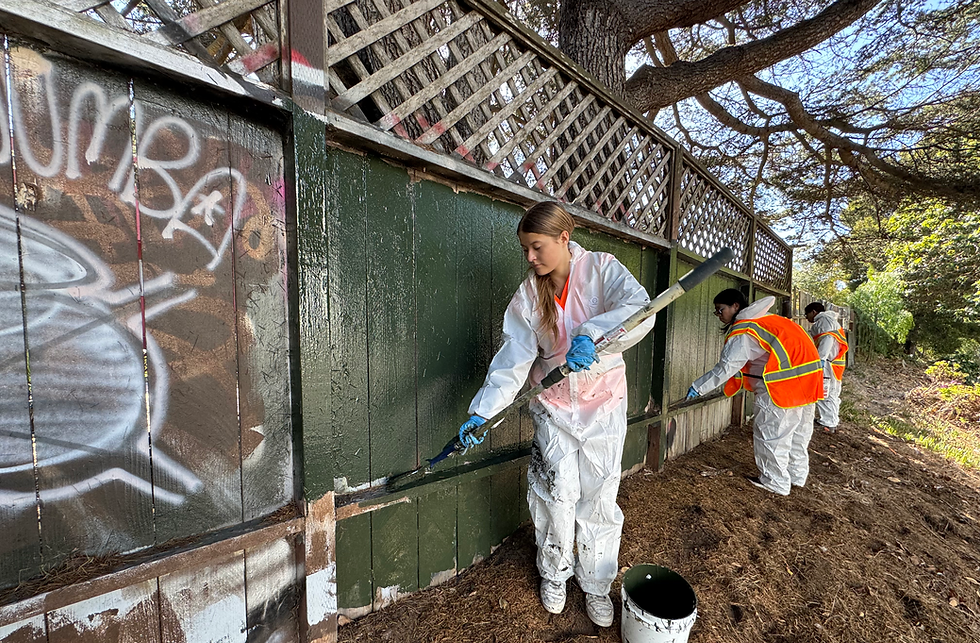
Volunteers paint a graffiti-covered fence near 19th Avenue and Eucalyptus Drive.
Bucketsful of Dedication Build Community, Improve Our Neighborhoods
Tucked away on a steep hillside in the Golden Gate Heights neighborhood, more than a dozen high school students donned orange vests and work gloves to spruce up the gardens abundant with native plants and succulents that line the magical 16th Avenue Tiled Steps.

Public Works staff arduously shovel gravel into buckets.
The big task of the day: adding 10,000 pounds of gravel to the plant beds as a mulching material to help prevent intrusive weeds. First, our crews shoveled the crushed rock from a flatbed truck into plastic buckets, then volunteers hand-carried them up the steep staircase one by one to the different sections of the garden.
Alice Yee Xavier, co-founder of the 16th Avenue Tiled Steps Project, serves as the chief steward of the gardens. She relies on the help of neighbors and other community volunteers to keep the landscaping in good shape.

Alice Yee Xavier
“I’ve been working with many schools, high schools and neighbors keeping the stairway maintained and the gardens looking good,” Xavier said, as she took a quick break from the action. “We’re expecting a big El Nino year so we’re out here pruning, clearing out the gutters so that the rain can come down, mulching. These kids … are absolutely doing a fantastic job.”

Volunteers fill bags with green waste removed from the gardens adjacent to the 16th Avenue Tiled Steps.
They were on hand as part of September’s Love Our City: Neighborhood Beautification Day – a volunteer greening and cleaning workday hosted by Public Works that touches down in a different supervisorial district every month. This month’s focused on Golden Gate Heights, Lakeside Village and other neighborhoods in District 7.
Leo Zhou, a senior at Lowell High School, was looking to get volunteer experience as he starts applying to college. He learned about the tiled steps gardening project on the Public Works website.

Lee Zhou
While the hook for college applications is what brought him out, “I realized I really like being out here and helping out the community,” Zhou said.
Working nearby was Deily Castanon, a senior at Burton High School who has a lot of volunteer experience through the Community Youth Center.
“I’m here because I feel like it’s important to help (the) community,” she said. “It isn’t my first time doing this kind of stuff and it’s just really fun volunteering and to meet new people.”

Deily Castanon
In all, 26 volunteers – 17 of them high schoolers – showed up to help with the gardening work at the tiled steps, located at Moraga Street between 15th Avenue and 16th Avenue.
It was just one of several projects that took place at the Sept. 12 Neighborhood Beautification Day event, which brought out a total of 73 community members. Teams painted out graffiti on 19th Avenue, planted trees on 14th Avenue, picked up litter on Ocean Avenue and more.
The monthly workday brings together community volunteers and Public Works staff to work side by side to take care of our neighborhoods. Next month, on Oct. 3, the team heads to the Richmond and other District 1 neighborhoods. New and seasoned volunteers are welcome to join.

