
In the Works
A Digital Journal from San Francisco Public Works
MARCH 2026


The Rest of the Lineup
San Francisco Street Trees: A Hot Topography at Geography Conference
Geographers came to town for an annual national conference, exploring firsthand the challenges and opportunities of Public Works’ StreetTreeSF initiative – one of the only fully funded municipal tree maintenance programs in the country.


NUMBERS
2026 YTD (through the end of February)
by the

68
blocks resurfaced

862
TREes PRUNED

3867
tons of debris collected

1182
potholes filled

72
curb ramps constructed

Volunteers, along with Mayor Daniel Lurie and Public Works arborists, plant a tree outside Francisco Middle School – the kickoff location for this year’s Arbor Day tree-planting event and fair.
Young Trees
and Community Spirit Take Root
on Arbor Day
One day, 250-plus volunteers, 100 newly planted street trees. Together, those numbers add up to a very successful Arbor Day celebration in San Francisco.

Near the corner of Broadway and Powell Street, enthusiastic young volunteers refill a tree basin after planting a new tree.
Public Works hosted the annual tribute to trees on March 14, a day when community volunteers worked alongside our professional arborist crews to grow San Francisco’s urban forest.
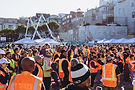
More than 200 volunteers of all ages gathered at Francisco Middle School to kick off our biggest volunteer event of the year.
One by one the trees were placed in their forever homes — the sidewalks along Jackson, Washington, Clay, Broadway, Hyde, Larkin, Pine, Bush, Fern, Geary, Cedar, Post, Francisco and Sutter streets.

Arborist Bryan Ong led a group of volunteers planting trees along Broadway.
Among the species that went into the ground: saucer magnolia, Eastern redbud and Chinese hackberry – trees that should do well in San Francisco’s urban environment.
This year’s Arbor Day tree-planting blitz focused on Chinatown, Jackson Square, Union Square, Lower Nob Hill, Nob Hill, North Beach and other District 3 neighborhoods.
The annual event is the single biggest tree-planting initiative of the year in San Francisco.

Our Arbor Day tree-planting event draws families and students from across San Francisco.
“Think about the power of this collective effort that brings a bounty of new life, beauty and environmental enhancements to our neighborhoods,” said Public Works Director Carla Short, a certified arborist. “Arbor Day in San Francisco is not just about growing our urban forest; it’s also about growing community.”

Carla Short, Public Works director and certified arborist, loves to dress for the occasion.
The volunteer ranks included families with toddlers eager to get their hands dirty, folks who showed up solo and left with new friends, shopkeepers and groups affiliated with schools, nonprofits, political clubs and neighborhood associations. There also was a strong showing of Public Works employees who joined on their day off.

A volunteer team near the corner of Powell and Vallejo streets puts the finishing touches on the cross-bracing for a newly planted street tree.
Each tree took up to an hour to plant. While Public Works urban forestry staff readied the basins in the days and weeks leading up to Arbor Day, there was still plenty to do day of: loosen the dirt around the tree roots, make sure the holes in the ground were deep enough (or not too deep), place the trees in the ground just right so they don’t lean and pack dirt around the base of the trees in such a way that it holds the trunks steady but still allows water to get to the roots.

A young volunteer from United Playaz packs dirt at the bottom of the tree basin to provide a stable foundation for the sapling.
And then each tree must be braced with tall stakes – pounded in by hand – and straps to keep them upright during their establishment period. At the end, it never hurts to offer the sapling words of encouragement along the lines of, “Have a good life, tree.”

A Public Works arborist drives a stake into the ground that will function as a brace for the young tree as it grows.
In addition to the tree-planting event, we also hosted our annual Arbor Day Fair on the grounds of Francisco Middle School. There, visitors could ride sky high in bucket trucks, build planter boxes and fill them with herbs and flowers, pet some friendly grazing goats, get their faces painted with fanciful designs and check out a variety of informational booths hosted by City departments and nonprofit groups with a focus on the environment.


Our Arbor Day Fair delighted visitors of all ages with fun-packed activities.
Helping us kick off the day’s festivities were Mayor Daniel Lurie, First Lady Becca Prowda, District 3 Supervisor Danny Sauter, SF Environment Director Tyrone Jue, County Transportation Authority chief Tilly Chang and Francisco Middle School Principal Hossien Koch, whose two sons, 5-year-old Cypress and 4-month-old Sebastian Alder, are named after trees.
“The trees we’re planting will have an impact for generations — cleaner air, greener streets, habitats for wildlife and better places for kids to learn and grow,” Lurie said. “I want to give a huge thanks to our Public Works urban forestry crews who care for these trees year-round so they can thrive.”

Family, friends, Public Works staff, nonprofits, community members and City officials were among the eager volunteers that showed up to plant trees around District 3.
Public Works oversees San Francisco’s 125,000-plus street trees and maintains them under StreetTreeSF, a program approved with overwhelming voter support in 2016 that sets aside approximately $19 million a year for tree care.
The department also is making advances to grow the City’s urban forest, planting new trees throughout the year in neighborhoods across town but with an emphasis on areas with low canopy coverage.

The Public Works urban forestry crew works really hard to prepare for Arbor Day.
San Francisco has been designated as a “Tree City USA” by the national Arbor Day Foundation in recognition of the Public Works Bureau of Urban Forestry’s commitment to manage and expand San Francisco’s tree canopy.
Planting trees is a great way to celebrate Arbor Day. And having the opportunity to join forces with friends, kin and neighbors makes this important undertaking even more meaningful.
Richard Manso was on the ground in Nob Hill planting more than half a dozen trees on Arbor Day, working with a spirited group of volunteers and Public Works crews. He wielded a shovel, digging holes and adding dirt once the trees were in the ground.


Public Works cement masons install new sidewalk adjacent to the Sunset Boulevard median.

Public Works acting Urban Forester Susan Nawbary addresses the tour group at the Street Tree Nursery.

Ross Pearson, volunteer and outreach coordinator at the Street Tree Nursery, provides the visiting geographers with insights on the operation.

Public Works arborists work on a towering tree on the Sunset Boulevard greenway.

Public Works arborists geared up and ready to prune.

A Public Works gardener adds new plants to the Sunset Boulevard greenway.

A crowd watches the swearing-in ceremony for three new police horses at the San Francisco Police Department’s Golden Gate Park stables.

A curious police horse sticks its head through an enclosure.

Public Works Project Manager Tony Abuyaghi shows off the new improvements to Public Works Director Carla Short.

The new and improved soil provides for better footing for the horses.


An attendee at the swearing-in ceremony meets police horse Ozzie.
Police horse Cinco gets some love from attendees at the swearing-in ceremony at the Golden Gate Park stables.

City staff tour the tight space beneath City Hall where the base isolator system that protects the structure sits.

City Hall stationary engineers pry open the entrance to the crawlspace below the building.


Public Works Chief Structural Engineer Raymond Lui explains how the base isolation system works.
The seismic retrofit at City Hall took place following the 1989 Loma Prieta Earthquake.


The use of a base isolation system allowed for minimal disruption of the richly ornate historic fabric. Among the other public buildings making use of the technology: the San Francisco Main Library, the City’s Emergency Operations Center on Turk Street and S.F. General Hospital.
“For a retrofit, it’s a pretty neat strategy in terms of trying to keep the context of the existing building as much as it can be,” Lui said.
Public Works provided architectural services to the seismic upgrade portion of the project. The department also contributed to the tenant improvement bid packages that included the complex restoration of the two majestic light courts and the information and security casework in the main lobby. Public Works provided continuous support to the makeover, from the relocation of 22 City departments through the design and construction phases.
In the event of a massive earthquake, Public Works would be tasked with inspecting the base isolators to assess them, looking for tears and permanent deformations that could weaken the system.
A plan shows the base isolator locations at City Hall.
Nick Holsapple, who oversees emergency management for Public Works, checks out photos of the base isolators.


On a recent March morning, Lui took a group of about a dozen City staff, including other structural engineers on his team, on a tour of the base isolator system.
“After an earthquake, we would probably send one of you in there to go look at these things,” Lui told those gathered. “Make sure that they’re not torn and ripped.”
After City Hall stationary engineers used crowbars and elbow grease to prop open one of the heavy trap doors that lead into the cramped space between the basement slab and building foundation, the tour attendees – one by one – climbed down a short ladder into the darkness.
“It’s quite dusty,” warned Bobby Lyons, a stationary engineer assigned to City Hall.
Underground, the group used furniture dollies to navigate the tight quarters, laying on their stomachs and rolling through the dim, constrained space – roughly 3 feet high – to catch a closer look at the base isolators.
Lyons recalled instances of earthquakes after the new system was installed where they could see objects moving or were alerted by tenants on the upper floors to shaking happening – but they couldn’t feel anything on the ground floor.
The building’s system was doing its job.
“It’s just swaying on the base isolators,” Lyons said.
An up-close look at a base isolator sitting below City Hall.
A Public Works employee climbs through a trap door to view the base isolators below.

A bird’s-eye rendering of a reimagined Harvey Milk Plaza.

Transformative Makeover Set for Harvey Milk Plaza
Opened in 1980, Harvey Milk Plaza is a key hub for San Francisco’s mass transit system as well as a symbolic front door to the iconic Castro neighborhood.
Now, nearly 50 years later, Public Works is set to lead a project that completely reimagines and reinvigorates this space, blending cutting-edge designs with nods to the plaza’s namesake and the district’s historical significance.
“This project originated with a community effort to renovate the plaza and honor Harvey Milk’s legacy,” said Christine Hunt, the Public Works project manager overseeing the effort.
In 2017, the Friends of Harvey Milk Plaza and the San Francisco Chapter of the American Institute of Architects held a design competition for the plaza, and the winning design was gifted to the City to review, verify and deliver as a project.
Community members attend a public forum to learn more about the Harvey Milk Plaza project.

.png)
The plaza is named after the pioneering gay politician and civil rights leader who operated a camera store on Castro Street and served on the Board of Supervisors until he was gunned down by an assassin in City Hall in 1978.
With the final design set and the San Francisco Municipal Transportation Agency’s improvements to the Castro Station’s elevator system nearly complete, Public Works is preparing for the plaza makeover.
Currently, while still functional, Harvey Milk Plaza isn’t exactly the most memorable or welcoming space. The plaza occupies a thin, triangular strip of land at the intersection of two busy, hilly thoroughfares at the southwest corner of Market and Castro streets.
To accommodate these challenging spatial restrictions, the plaza’s original design is a multi-tiered crisscrossing of long, thin walkways and high retaining walls lined with massive concrete planter boxes.
The plaza’s new design is more open, cohesive and visually striking. It will include three new gathering spaces – the Gallery, the Grove and the Beacon – each with its own eye-catching combination of public art, green space and design elements inspired by Castro District history.
The redesigned plaza will include a host of accessibility improvements. The entire area will be regraded, repaved and newly landscaped to make the plaza easier and more enjoyable to navigate. There will be new sculptural landscape elements throughout the plaza, each designed to seamlessly integrate with pedestrian walkways and planted areas, creating uninterrupted, clear sight lines and a more welcoming, open environment.
Harvey Milk speaks in front of City Hall.
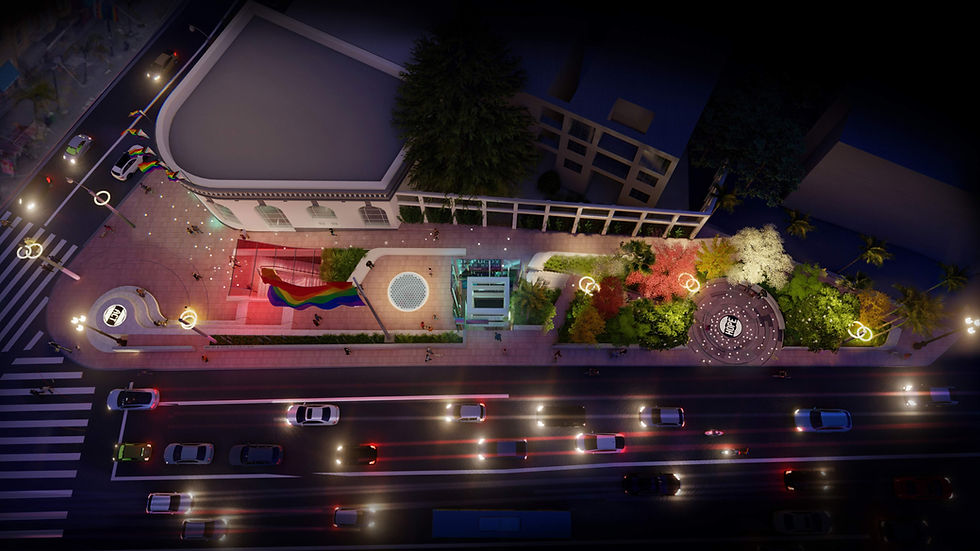
A rendering of what the new plaza will look like from above.
To complement the new glass elevator at the plaza, we will be improving both the stairway and escalator that connect the plaza with the Castro Muni station below.
We will be constructing a new staircase with a simpler design that will make it easier to navigate the space compared to the plaza’s current curving, three-tiered setup. Both this new stairway and the adjacent escalator will be protected from the elements by a pink-tinted glass canopy. This striking, playful design is called the Bullhorn, which, with its distinct shape, is a nod to Milk’s tendency to use a bullhorn during marches, speeches and advocacy work.
When asked what it will take for this project to be delivered successfully, Hunt, the Public Works project manager, noted three main factors: “We need clear goals, consistent communication and effective coordination across all teams involved.”
With construction starting in late 2026, Hunt and her team are already ahead of the curve when it comes to communication.
On March 11, Public Works hosted an open house event for the project at the nearby Eureka Valley Recreation Center. Staff from Public Works, the San Francisco Arts Commission and several supporting community groups were on hand to share information about the project’s design, anticipated construction schedule and construction-related impacts. Renderings of the project were on display with detailed depictions of the plaza’s new design, providing a visual preview of what can be expected once the project is complete.
The Harvey Milk Plaza Improvements Project is scheduled to break ground this winter, with construction wrapping up by the end of 2028.
For more information, visit the project webpage.

Street cleaners tackle the heaps of post-parade trash left behind on Market Street.

Post-Parade Pickup
This year’s Chinese New Year Parade went off with a bang – make that thousands of bangs from the continuous bursts of firecrackers along the 1.3-mile route. The quick-succession pop, pop, pops excited the multi-generational crowds and left behind a stream of red paper shreds from the spent explosive devices.
But the firecracker detritus and the other trash generated by revelers during the March 7 celebration – deemed the largest Lunar New Year parade outside of Asia – didn’t stay on the ground long.
Soon after the last contingent took off, Public Works street cleaners and truck drivers got to work.
Using brooms, pickers, shovels, rakes, power washers, blowers, mechanical sweepers and flusher trucks, the team of more than three dozen Public Works employees worked a highly choreographed operation to get the roads and sidewalks along the route back in good shape.
Public Works street cleaning trucks follow the parade.


By dawn Sunday, you wouldn’t have even known that a major parade had snaked its way through downtown and Chinatown, drawing tens of thousands of participants and onlookers.
We also had a team of street inspectors working the parade route to enforce illegal vending rules, and our truck drivers staffed blocker trucks to keep people safe.
A week later, we conducted a similar operation to clean up after the St. Patrick’s Day Parade. With the new season of civic celebrations well underway, we’re gearing up for Pride, the Italian Heritage Parade, Carnaval and Bay to Breakers.
While parades don’t happen every day, they are at the core of what we do – making sure that San Francisco shines as a go-to destination for major civic events that showcase our diverse, beautiful and exciting city.
After the parade passes by, Public Works crews power wash the sidewalks and trash cans.
Cleanup crews wait for the parade to move down the street so they can get to work.

The award-winning Potrero Gateway project features public artwork.


Potrero Gateway Project Lands Award
Less than a year ago, Public Works staff, City officials, neighbors and community advocates gathered near a highway overpass in Potrero Hill to celebrate the completion of a transformative streetscape project.
Now there’s another reason to cheer: a prestigious award.
The Potrero Gateway project – led by Public Works, from design to implementation – was recently recognized as a 2026 Project of the Year by the American Public Works Association Northern California Chapter.
The project – underpinned by a community-driven vision to turn an unsightly patch of public land into a more welcoming corridor near a freeway offramp – helped create a safer passageway under the U.S. Highway 101 overpass on 17th Street, between San Bruno Avenue and Vermont Street, as well as the adjacent block of Vermont Street, between 17th Street and Mariposa Street.
City officials and community partners celebrated the Potrero Gateway project with a ribbon-cutting ceremony on April 28, 2025.


Both stretches had been identified by the San Francisco Municipal Transportation Agency’s Vision Zero team as needing upgrades to make the area safer and more accessible for people who walk and bike.
Crews widened sidewalks, built corner bulb-outs to shorten crossing distances, constructed concrete dividers to protect both eastbound and westbound bike lanes and installed new metal picket fencing along the area’s perimeter and new lighting to illuminate pedestrian pathways underneath the freeway. Landscaped elements complement the streetscape and safety improvements.
In partnership with the San Francisco Arts Commission, four new public art sculptures were installed on both sides of the overhead freeway – two at the corner of 17th Street and Vermont Street and another two at 17th Street and San Bruno Avenue.
Projects like Potrero Gateway are vital to making San Francisco safer and more welcoming. What the project might lack in size, it more than makes up for in impact.
Congratulations to the entire project team for their outstanding work!
The streetscape improvements included new safety elements for people who walk and bike.
Public Works staff who worked on the project gather at the ribbon-cutting event.